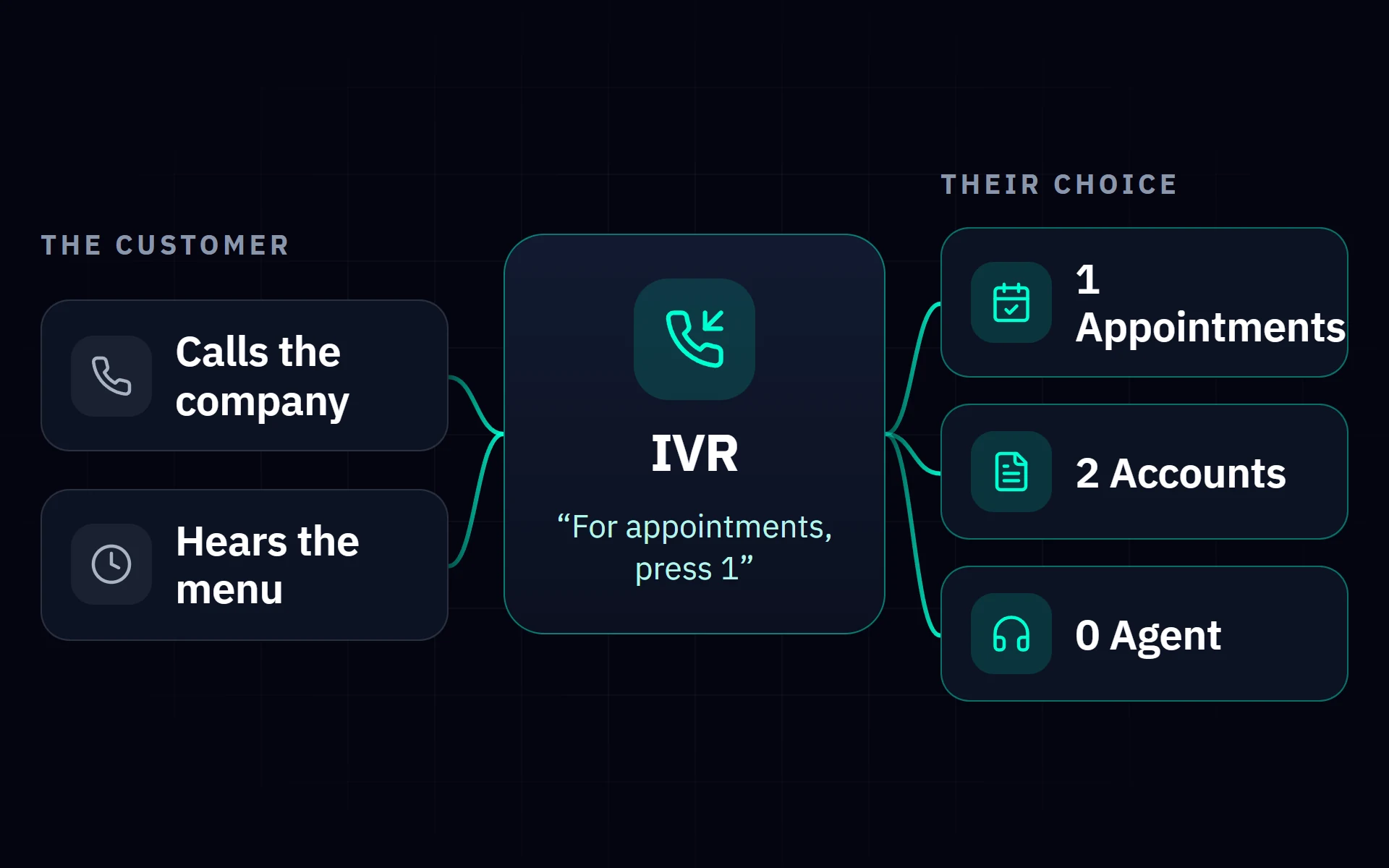
IVR is the voice menu you hear when you call a company: “for appointments press 1, for accounts press 2”. The name stands for Interactive Voice Response.
This guide explains what IVR is, how it works, where it really serves callers and where it wears them out, how it compares with a conversation with artificial intelligence, and six rules for building a menu that does not drive customers away.
What IVR is
IVR is a system that answers the phone automatically, plays recorded messages and waits for the caller to choose something by pressing a key or saying a word. Based on the choice, it gives a piece of information or sends the call to the right department.
It is not the same as voicemail. Voicemail records a message when nobody answers. IVR sits before the answer and decides where the call goes.
How an IVR works
Every key on a phone produces a sound made of two frequencies together. The system recognises the sound and knows which key was pressed. The technique is called DTMF (Dual-Tone Multi-Frequency) and is standardised internationally by the International Telecommunication Union in Recommendation ITU-T Q.23. That is why the same menu works from any phone, landline or mobile.
A call to an IVR goes through four stages:
When IVR works well
IVR has been around for decades because for some jobs it is the right answer:
When IVR wears the customer out
IVR asks the customer to do a job that reception used to do: decide which department their request belongs to. When the request fits none of the options, the trouble starts.
IVR or a conversation with AI: the comparison
The alternative today is a digital assistant that asks “how can I help?” and understands the answer the way the customer says it. The difference is not the voice, it is who does the sorting.
| IVR | Conversation with AI | |
|---|---|---|
| How the call starts | With a list of options | With an open question |
| What the customer does | Chooses a number | Says what they want in their own words |
| A request outside the options | Not provided for | Understands it or hands it to a person |
| Completion | Routes the call | Answers, books an appointment, takes a message |
| After hours | A recorded message | Serves as usual |
| Entering numbers and PINs | Exact, with the keypad | Spoken, with confirmation |
| Fits when | Options are few and stable | Requests are many and phrased freely |
The two coexist. An AI voice agent can answer first and transfer to the department you already have, without changing your phone system. We describe how that works for businesses with many calls on the AI phone system page. As with any artificial intelligence system, the caller must know they are talking to a machine, as the European AI Act requires.
6 rules for a better IVR menu
If IVR is the right answer for you, these are the rules we suggest. They come from the same problem we solve every day: getting the customer to an answer in the fewest steps.
If you have no phone system at all, you do not need IVR to stop missing calls. Call forwarding to someone who answers is enough, for example an AI answering service.
FAQ
What does IVR stand for?
What is the difference between IVR and voicemail?
What is DTMF?
Does a small business need IVR?
Can artificial intelligence replace IVR?
How many options should an IVR menu have?
Live hotel demo
Talk to a hotel AI voice agent demo now
You can call this number to talk to a demo AI voice agent for a hotel.
Hear how an agent answers without a menu.
Tell us what your customers ask on the phone and we will show you on a call.
Book a Call