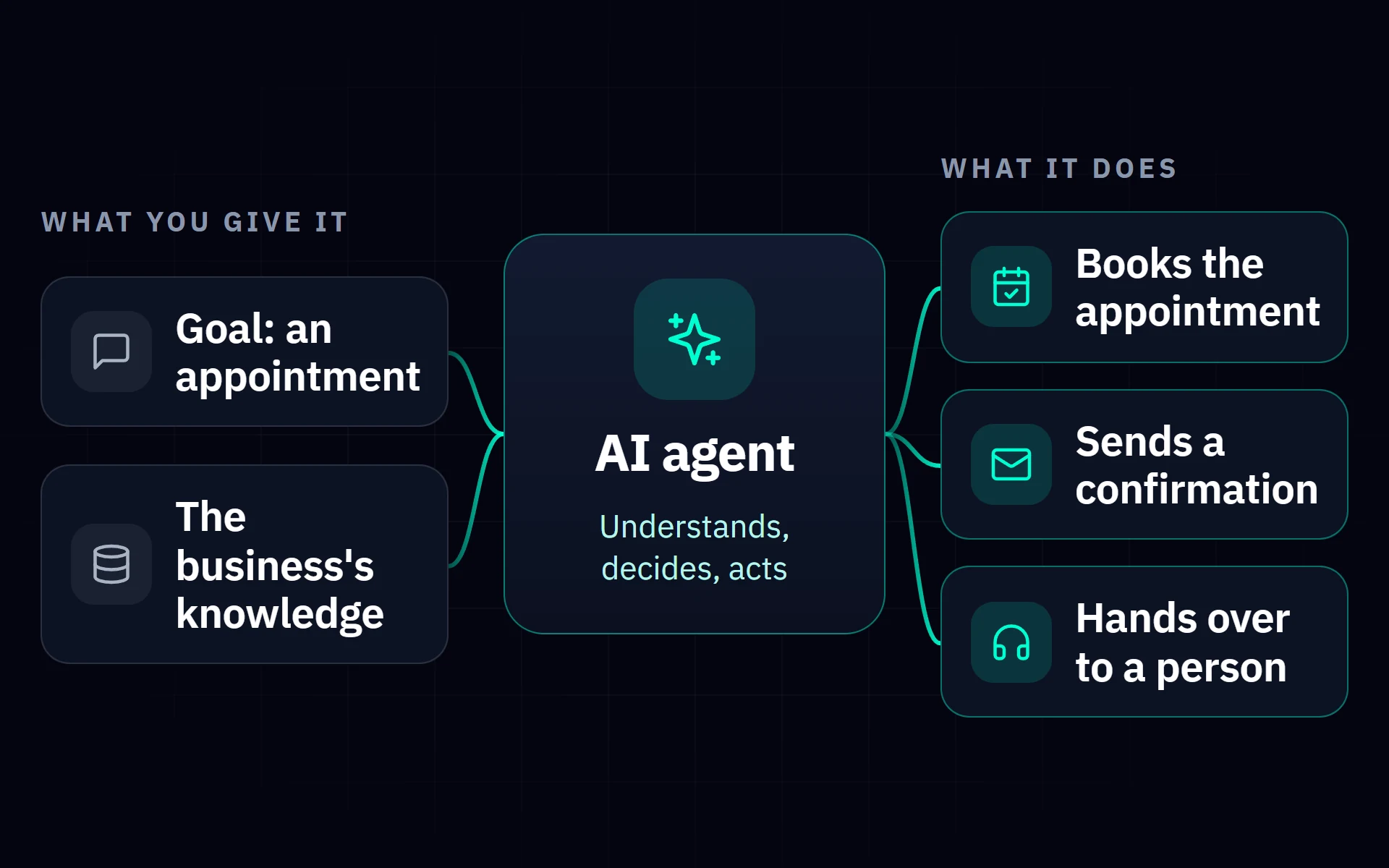
An AI agent is an artificial intelligence system that does more than answer questions. It takes a goal, decides which steps are needed and carries them out: it books an appointment, sends a confirmation, records a request.
The term is now used for almost every product with artificial intelligence in it, so it is worth making clear. This guide explains what AI agents are, how they differ from a chatbot or an automation, examples in businesses and what to ask before you put one in yours. We write it as a team that builds and runs such agents every day.
What an AI agent is
In computer science, an agent is anything that perceives its environment and acts upon it. That is the definition in the field's standard university textbook, “Artificial Intelligence: A Modern Approach” by Russell and Norvig. So an AI agent is not defined by how cleverly it talks, but by the fact that it does something.
The European regulation on artificial intelligence uses the same idea when it describes systems that operate “with varying levels of autonomy”. Autonomy is the key word: an agent does not wait for an instruction at every step.
In one sentence: a chatbot answers, an AI agent completes a job. If something has changed in your calendar, CRM or email by the end of the conversation, you were talking to an agent.
AI agent, chatbot, assistant or automation: the differences
The four terms are often confused. They differ in who decides the next step.
| What it does | Who decides the next step | Example | |
|---|---|---|---|
| Automation | Always runs the same steps | Whoever set it up, in advance | A reminder SMS one day before every appointment |
| Chatbot | Answers questions | The user, with their next question | “What time do you close on Saturday?” |
| AI assistant | Helps a person with their work | The person using it | A draft of an email |
| AI agent | Reaches a goal in as many steps as it takes | The agent itself, within the rules set for it | Finds a free slot, books the appointment, sends a confirmation |
In practice the lines are not absolute. A chatbot that books appointments is already acting as an agent, and an agent uses automations to carry out its actions.
What an AI agent is made of
Wherever it works, every agent that holds up in real use has six parts:
Examples of AI agents in businesses
The examples that work today in small and medium businesses have one thing in common: one clear job that repeats.
Since March 2026 Epic Voice's agents have handled more than 102,000 calls for Greek businesses. The lesson from them is simple: the agent that succeeds has one job, not ten.
6 questions before you put an AI agent in your business
The answers show whether you are looking at an agent that will work or at a demonstration:
What an AI agent costs
It depends on whether you are buying a tool, a project or a service. A tool you set up and maintain yourself. A custom project has a development cost and separate maintenance. A service has a one-off setup and a fixed monthly fee, and the provider takes on running it.
One concrete example: at Epic Voice an AI voice agent starts at €79 per month with a one-off €199 setup, and the AI chatbot costs €149 to set up and from €19 per month. All plans are on the pricing page.
If you are not sure which form suits you, see how an AI agency works and where artificial intelligence in business makes sense.
FAQ
What are AI agents in plain words?
What is the difference between an AI agent and a chatbot?
What are examples of AI agents for businesses?
Are AI agents safe?
Do I need technical knowledge to get an AI agent?
How much does an AI agent cost?
Live hotel demo
Talk to a hotel AI voice agent demo now
You can call this number to talk to a demo AI voice agent for a hotel.
See an AI agent do one job properly.
Tell us which job you want off your plate and we will show you how it is done.
Book a Call