Artificial intelligence in business is no longer a topic for large organisations only. In 2025 one in five EU enterprises used it. In Greece the share was less than half of that.
This guide shows where Greek businesses stand according to official figures, which uses of artificial intelligence make sense for a small or medium business, examples by industry, the categories of AI tools and five steps to get started.
How many businesses use artificial intelligence
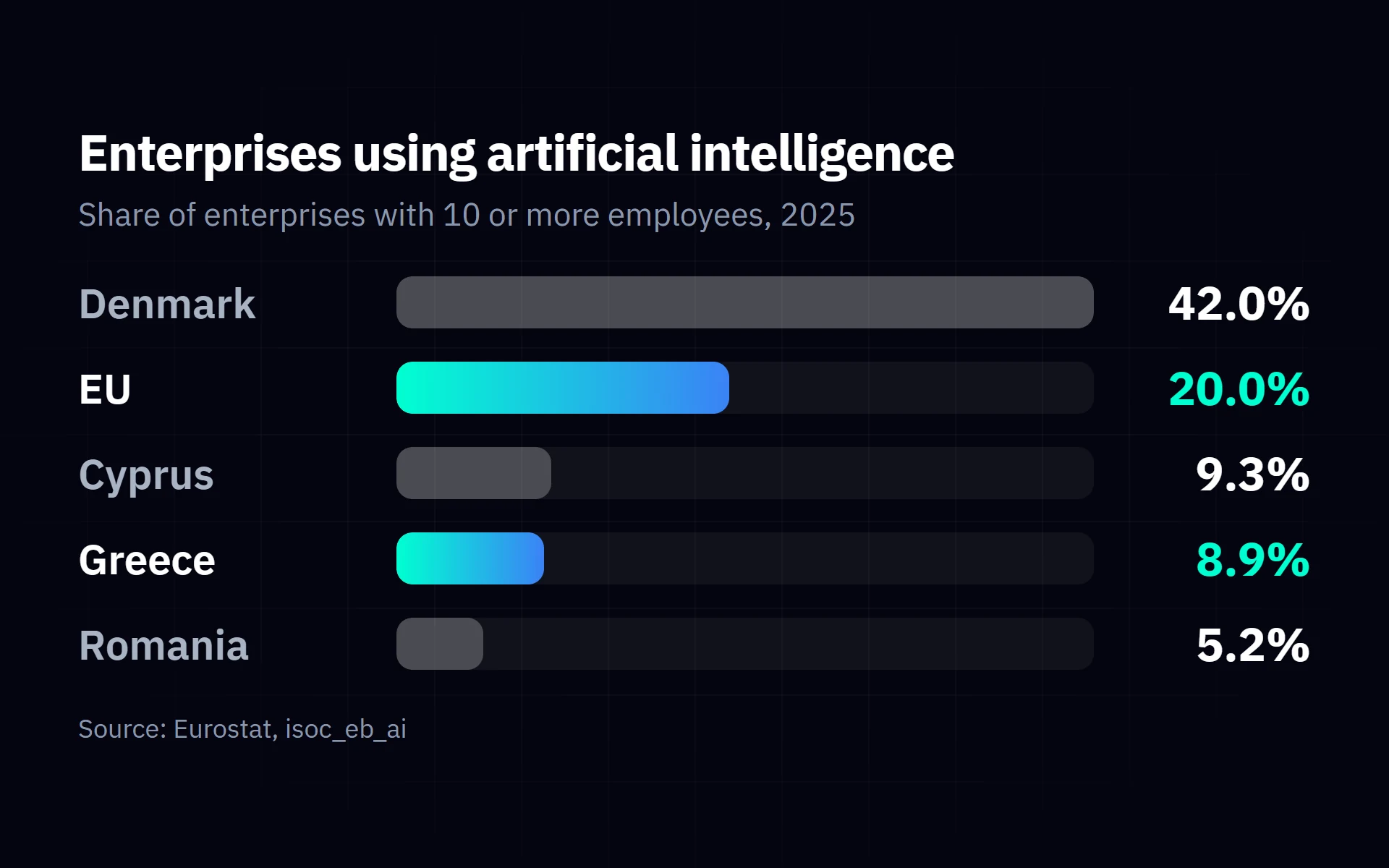
According to Eurostat, in 2025 20.0% of EU enterprises with 10 or more employees used artificial intelligence technologies, up from 13.5% in 2024 and 8.1% in 2023. Denmark came first with 42.0%.
In Greece the share was 8.9% in 2025, after 9.8% in 2024 and 4.0% in 2023. The gap to the European average widened within a year.
Size matters: AI was used by 17.0% of small EU enterprises, 30.4% of medium ones and 55.0% of large ones.
The picture changes when we look at people rather than businesses. In 2025, 83.5% of people aged 16 to 24 in Greece used generative artificial intelligence tools, the highest share in the EU, where the average was 63.8%.
The customers and employees of Greek businesses already use AI in their daily lives. The businesses themselves do not yet. That gap is also the room available to whoever moves now.
Uses of artificial intelligence in a business
Of the EU enterprises that use AI, 34.7% use it in sales and marketing and 31.1% in business administration and management. More useful than the categories is to see which job it takes on at each point:
| Point in the business | What AI takes on | What stays with you |
|---|---|---|
| Phone | Answers, gives information, books appointments, takes a message | Calls that need judgement or negotiation |
| Website | Answers visitors' questions in writing, collects details | Conversations handed to a person |
| Appointments | Booking, rescheduling, cancelling, reminding | The schedule and the exceptions |
| After the contact | CRM entry, email, SMS, review request | The relationship with the customer |
| Office | Drafts, summaries, translations, minutes | Checking and the final decision |
The first four rows are about your customers and need something that works on its own, around the clock. The fifth is about your team, and a tool someone uses is enough there. That distinction also decides who you will need to set it up, as we explain in who can help you bring AI into your company.
Examples of artificial intelligence by industry
The sectors with the highest use in the EU are information and communication (62.5%) and professional, scientific and technical activities (40.4%). Construction is last with 10.8%. In businesses that serve the public, the examples are more specific:
AI tools for business: the categories
The names of the tools change every few months. The categories do not. If you know which category your need belongs to, you can compare whatever is on the market at that moment.
| Tool category | What it does | What to watch |
|---|---|---|
| General-purpose chat assistant | Texts, emails, summaries, ideas | Do not enter customers' personal data without an agreement with the provider |
| Transcription and minutes | Turns speech into text | How well it understands Greek and names |
| Translation | Texts and conversations in other languages | Human review for contracts and medical texts |
| Image and video generation | Material for social media and ads | Labelling of content generated by AI |
| AI inside the software you have | Features in accounting, CRM and office programs | Ask what your plan already includes |
| Customer-facing digital assistant | Answers on the phone or the website | What it does when it does not know, and who maintains it |
| Automations | Connect the above to calendar, email and CRM | Who fixes it when something changes |
The last two categories are the ones we build: AI voice agents for the phone, an AI chatbot for the website and whatever follows each contact. For the difference between a tool and a system that acts on its own, see the guide to AI agents.
What a business needs in order to go ahead
Eurostat asked enterprises that considered artificial intelligence and did not use it why they stopped. The top three answers have nothing to do with the technology:
Only 20.7% answered that artificial intelligence is not useful for the business. The obstacle is how, not whether.
What the AI Act asks of a business
Regulation (EU) 2024/1689 on artificial intelligence has applied since 2 August 2026, with some exceptions. It sorts systems into four levels of risk, as described by the European Commission:
Since 2 February 2025 the AI literacy obligation also applies: those who use AI systems on behalf of the business must have the basic knowledge to do so properly. This text is for information and is not legal advice.
What our own calls show
Since March 2026 Epic Voice's AI voice agents have handled more than 102,000 incoming and outbound calls for Greek businesses. About 4 in 10 incoming calls arrived outside office hours, that is outside Monday to Friday, 09:00 to 17:00.
That is why we suggest starting with customer communication. It is the work that repeats the most, is easy to measure and is lost entirely when nobody is there to answer.
Where to start: 5 steps
You do not need a strategy of many pages. You need one problem and a way to measure whether it was solved.
If you would rather understand the basic concepts first, start with what artificial intelligence is.
FAQ
How is artificial intelligence used in business?
How many Greek businesses use artificial intelligence?
What are examples of artificial intelligence in a small business?
Which AI tools does a business need?
Is it legal to use artificial intelligence in customer service?
How much does artificial intelligence cost a business?
Live hotel demo
Talk to a hotel AI voice agent demo now
You can call this number to talk to a demo AI voice agent for a hotel.
Tell us which problem you want to solve.
We will tell you whether artificial intelligence can solve it, and how.
Book a Call