Artificial intelligence (AI) is the ability of a computer system to do work that usually takes human thinking: understanding language, recognising images and speech, predicting and making decisions.
The difference from an ordinary program is that nobody writes every rule for it. It learns from examples. Below you will see what artificial intelligence is, where it started, how it works, where you already use it without thinking about it and what European law says.
What artificial intelligence is
There is no single definition, but there are two official ones that agree on the essentials. The European regulation on artificial intelligence (AI Act, Article 3) describes an AI system as a machine-based system that operates with varying levels of autonomy and that, from the input it receives, infers how to generate outputs such as predictions, content, recommendations or decisions.
The OECD gives almost the same description and adds that systems differ in how autonomous they are and in how much they adapt after they go into use.
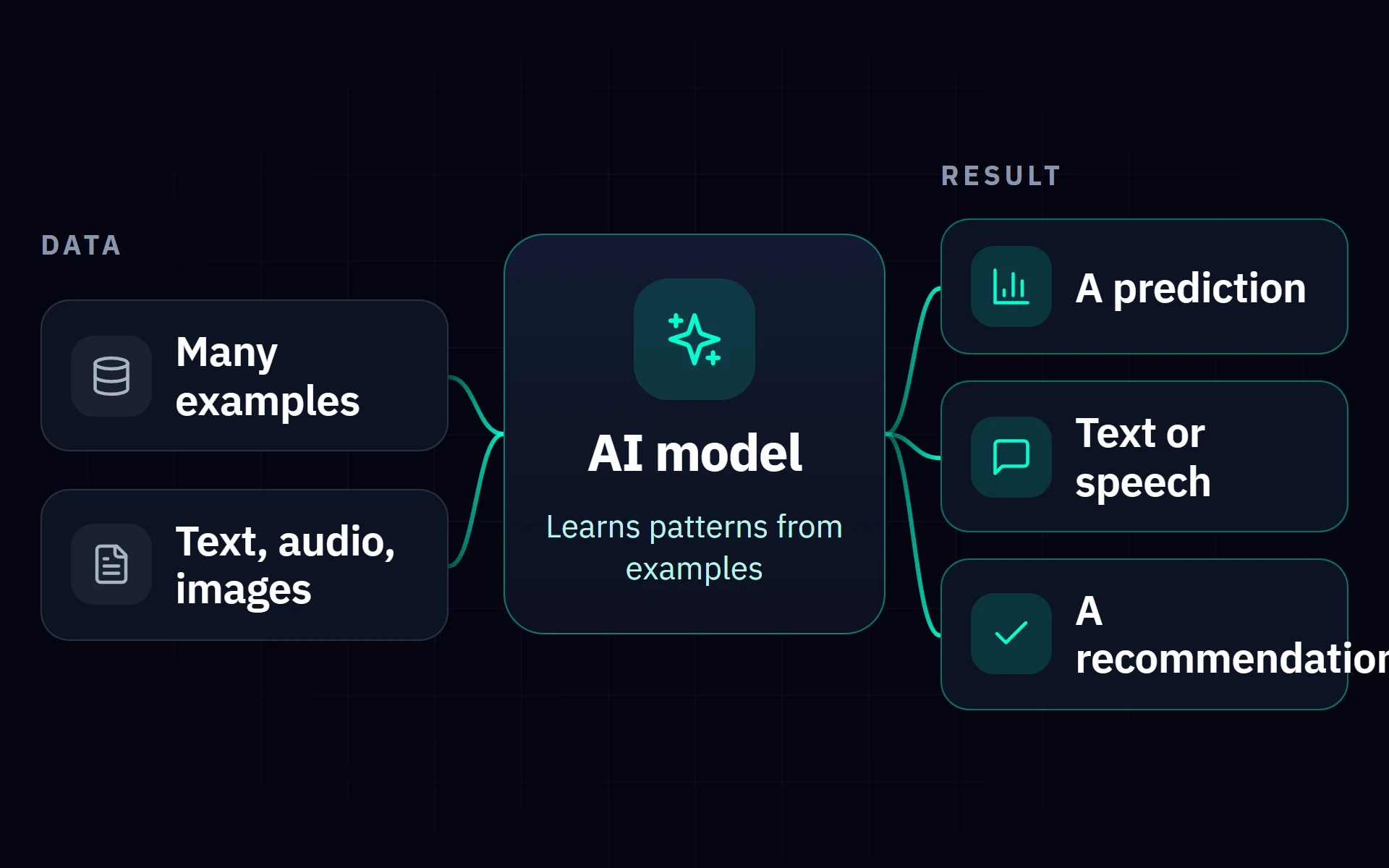
Keep three words from the definitions: input, inference, output. An artificial intelligence system takes input, draws a conclusion nobody wrote for it explicitly and produces an output.
Where it started: a short history
The idea is older than the computers we have today. Four moments are enough to follow the path:
| Year | What happened | Why it matters |
|---|---|---|
| 1950 | Alan Turing publishes the paper “Computing Machinery and Intelligence” | He asks whether machines can think and proposes a way to test it |
| 1956 | A summer workshop at Dartmouth College, organised by John McCarthy | The term “artificial intelligence” is established there and the research field is born |
| 1966 | The ELIZA program at MIT | The first well-known written conversation partner, an ancestor of today's chatbots |
| 2024 | The Nobel Prize in Physics goes to John Hopfield and Geoffrey Hinton | For foundational discoveries that made machine learning with artificial neural networks possible |
How artificial intelligence works
In a classic program, the programmer writes the rules: if this happens, do that. In artificial intelligence it is the other way round. We give the system many examples and it finds the rules that explain them on its own.
The types of artificial intelligence
All the systems we use today are specialised: they do one category of tasks well. These are the terms you will hear most often:
| Term | What it means | Example |
|---|---|---|
| Machine learning | The system learns from data instead of following written rules | The spam filter |
| Neural networks and deep learning | Machine learning with many layers, for complex patterns | Face recognition on a phone |
| Generative artificial intelligence | Creates new content: text, image, audio, video | An assistant that drafts an email |
| Language models | Understand and produce text in natural language | Translation, summarising, conversation |
| Speech recognition and synthesis | Turn speech into text and text into a voice | Dictating a message, voice assistants |
| Computer vision | Recognises what is in images and video | Reading number plates, quality checks on a production line |
Examples of artificial intelligence in everyday life
You probably use it many times a day, with no “AI” label anywhere:
How widespread artificial intelligence is
According to Eurostat, in 2025 32.7% of people aged 16 to 74 in the EU used generative artificial intelligence tools. Most used them for personal purposes (25.1%), fewer for work (15.1%) and for formal education (9.4%).
Among people aged 16 to 24 the EU share was 63.8%. Greece came first with 83.5%.
Among businesses the picture is reversed: artificial intelligence was used by 20.0% of EU enterprises with 10 or more employees and by 8.9% of Greek ones. What that means, and where it makes sense for a business to start, is in the guide to artificial intelligence in business.
What the law says: the European AI Act
The EU has the first comprehensive law on artificial intelligence, Regulation (EU) 2024/1689. It has applied since 2 August 2026, with some exceptions, and regulates systems according to risk, as the European Commission explains:
What artificial intelligence means for a business
For a business, artificial intelligence is not a product you buy. It is a way of getting a specific job done: answering the phone, booking appointments, answering the questions on the website.
To see what that looks like in practice, read what AI agents are, what a chatbot is and how AI voice agents work on the phone. If you are looking for someone to take it on, see what an artificial intelligence company does.
FAQ
What is artificial intelligence in plain words?
What does AI stand for?
Who invented artificial intelligence?
What is the difference between artificial intelligence and machine learning?
Is there free artificial intelligence?
Live hotel demo
Talk to a hotel AI voice agent demo now
You can call this number to talk to a demo AI voice agent for a hotel.
Hear artificial intelligence at work on a real call.
Listen to how an AI voice agent answers in Greek and ask us anything you like.
Book a Call