A chatbot is a program that holds a written conversation with people. You meet it as a chat window on a website: the visitor types a question and gets an answer at once, without waiting for a member of staff.
The word covers very different things, from a menu of buttons to an artificial intelligence system that understands free text. This guide explains what a chatbot is, how it works, the types you will find, what it costs and what to ask before you put one in your business. We write it as a team that sets up chatbots for Greek businesses.
What a chatbot is
A chatbot (from chat and robot) is software that takes a message in natural language and returns a reply. The idea is old. In 1966 Joseph Weizenbaum at MIT presented ELIZA, a program that looked for keywords in the user's sentence and answered with ready-made patterns. It understood nothing, and yet many users felt they were talking to someone.
What has changed is that a chatbot built on artificial intelligence needs no ready-made patterns. It reads the whole question, takes into account what was said earlier in the same conversation and composes the answer from the information it has been given.
In one sentence: a chatbot is your business's written conversation partner. How useful it is depends on what it knows, what it can do and what it does when it does not know.
How a chatbot works
Every message from a visitor goes through four steps, in a few seconds:
The types of chatbot: rule-based, AI and hybrid
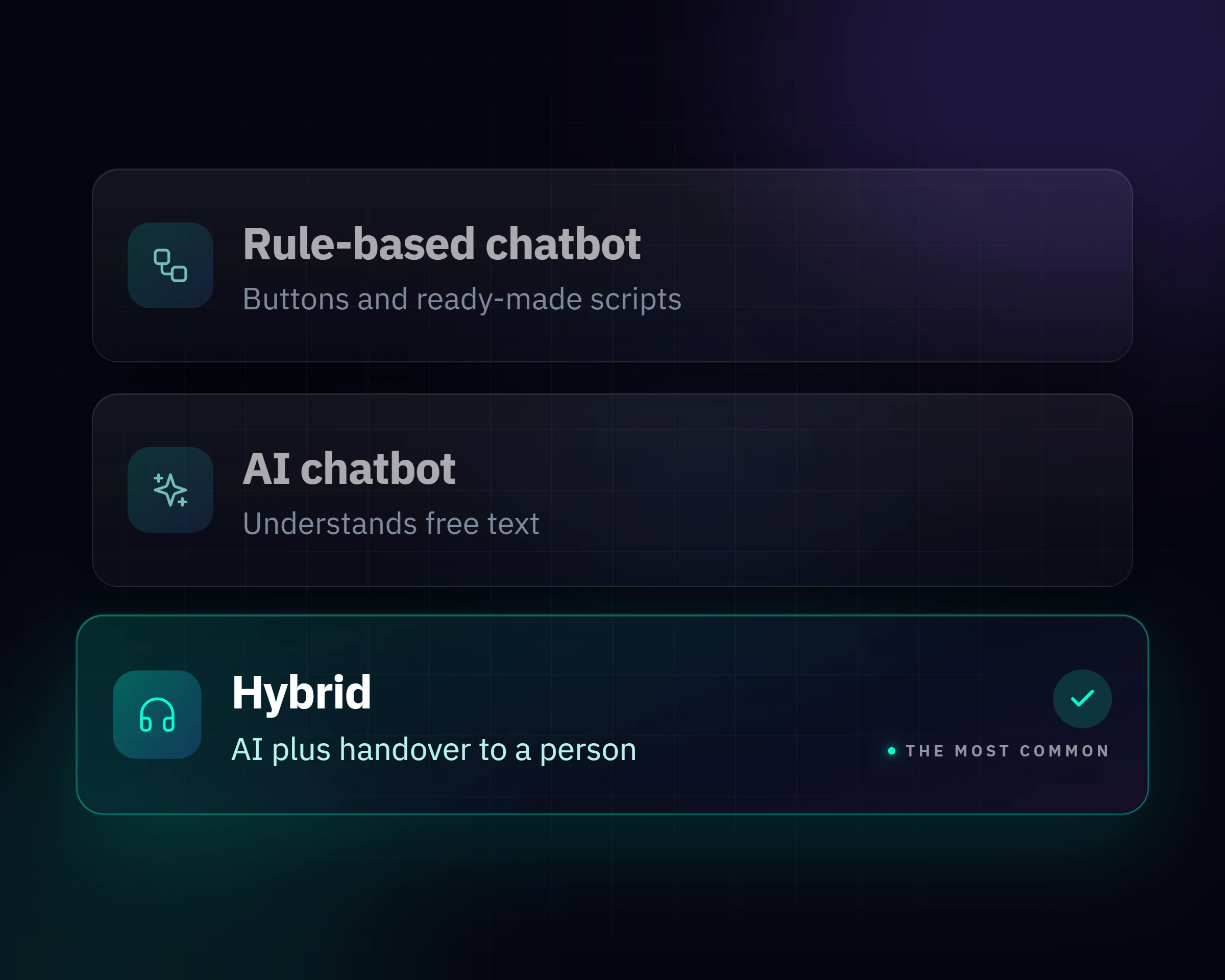
You will find three types on the market. None is better than the others at everything. They differ in how much freedom the visitor has and how much work it takes to keep them accurate.
| Type | How it answers | Fits when |
|---|---|---|
| Rule-based | Buttons and ready-made scripts | Questions are few and the same every time |
| AI | Free text, from the business's information | Questions are many and phrased differently |
| Hybrid | AI for the routine, a person for the rest | Some topics need judgement or negotiation |
What a chatbot does in a business
Analysing written language is the most common use of artificial intelligence among EU enterprises: in 2025 it was used by 11.8% of enterprises with 10 or more employees, according to Eurostat. The chatbot is its most visible form. In practice it takes on five jobs:
At Epic Voice we set up an AI website chatbot that answers only from the information you have given it. It does not invent prices or availability. When it does not know something it says so, asks for the visitor's details and the conversation passes to you.
What a chatbot costs
The cost depends on who sets it up and who maintains it. There are three models, and it helps to know which one you are being offered before you compare prices.
| Model | What you pay | Who does the work |
|---|---|---|
| A platform you set up yourself | A monthly subscription, often per conversation or per user | You: content, settings, corrections |
| Custom development | A project fee and separate maintenance | The software company delivers it, you keep it up to date |
| A service that builds and runs it | A one-off setup and a fixed monthly fee | The provider: training, installation, changes |
One concrete example: at Epic Voice the AI chatbot costs €149 to set up and from €19 per month. Setup covers training it on your business's information, matching your colours and placing it on the website. The cost that gets forgotten in every model is the time it takes to keep the information accurate when prices and opening hours change.
What the law asks of chatbots: the AI Act and GDPR
Two European regulations concern every business that deploys a chatbot.
Regulation (EU) 2024/1689 on artificial intelligence (the AI Act) has applied since 2 August 2026, with some exceptions. For chatbots it asks for transparency: as the European Commission puts it, humans should be made aware that they are interacting with a machine. A chatbot that introduces itself as a digital assistant covers this point.
GDPR applies as it does to any contact form. If the chatbot asks for a name, phone number or email, the visitor must know who processes them and for what purpose, and you need a written data processing agreement with the chatbot provider.
What to ask before you put a chatbot on your site
Six questions before you decide:
A chatbot is only one kind of digital assistant. To see what else artificial intelligence can take on, read about AI agents and artificial intelligence in business.
FAQ
What is a chatbot in simple terms?
What is the difference between a chatbot and an AI chatbot?
How much does a chatbot cost a business?
Can a chatbot book appointments?
Does a chatbot have to say it is AI?
Can I get a chatbot for free?
How long does it take to have a chatbot ready?
Live hotel demo
Talk to a hotel AI voice agent demo now
You can call this number to talk to a demo AI voice agent for a hotel.
See a chatbot answer for your own business.
Tell us what your customers ask and we will show you how it would answer.
Book a Call